


What Size Air Compressor Do You Need for a Jackhammer, Breaker or Drill?
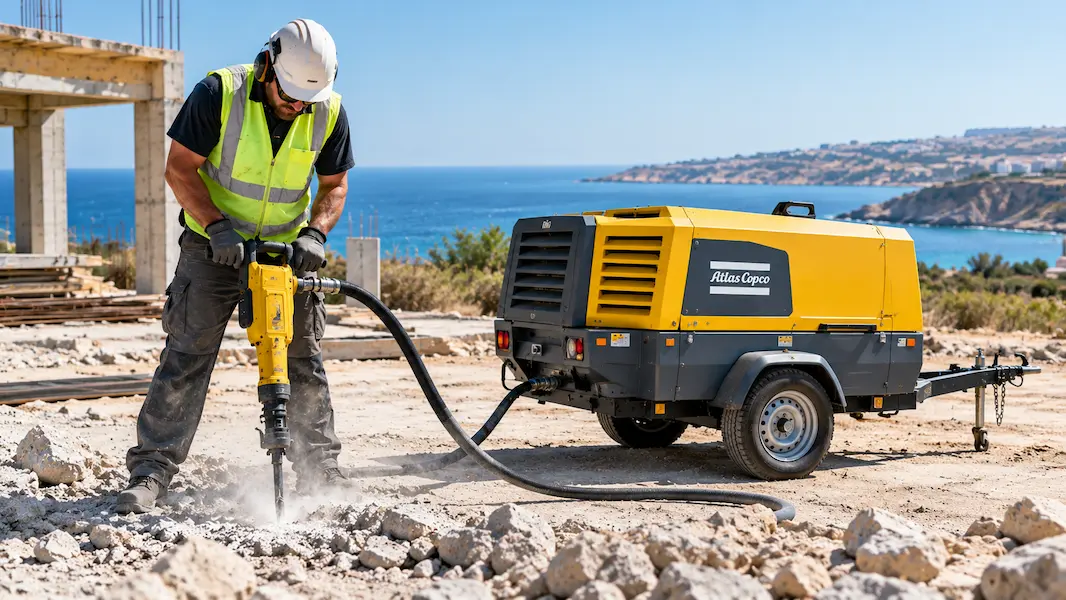
A jackhammer is only as strong as the air behind it. On a compressor that’s too small, it hits weakly and stalls. On one that’s far too big, you’re towing and fuelling capacity you don’t use. This guide shows how to choose a compressor for a jackhammer, breaker or rock drill, using real airflow figures and the Atlas Copco air compressors we supply.
How Much Air Does a Jackhammer Use?
Tools and compressors are both rated by airflow. You’ll see it written as cfm (cubic feet per minute), l/s or m³/min. Start with the tool, because its figure sets the minimum. As a rough guide, 1 m³/min is about 35 cfm, and 1 l/s is about 2.1 cfm.
Heavier breakers hit harder and use more air. Atlas Copco’s own breaker specifications show how wide the spread is:
| Tool | Example model | Weight | Air use |
|---|---|---|---|
| Light breaker | Atlas Copco TEX 150 PE | 19 kg | 53 cfm (1.5 m³/min) |
| Medium breaker | Atlas Copco TEX 230 PE | 25 kg | 64 cfm (1.8 m³/min) |
| Heavy breaker | Atlas Copco TEX 40 PE | 42 kg | 85 cfm (2.4 m³/min) |
| Rock drill | Atlas Copco RH 571-5L | 18 kg | 83 cfm (2.3 m³/min) |
The breaker figures are at 6 bar, the pressure most site tools work at. Your own tool’s manual or data plate gives its exact figure.
Matching the Compressor to Your Tools
Add up the air every tool uses when they run at the same time. Then pick a compressor that delivers more than that total. Each Atlas Copco compressor below is a towable diesel unit, so it works on sites with no mains power. These are the starting points we use:
| Job | Air needed | Our starting point | Its output |
|---|---|---|---|
| One light or medium breaker | 53 to 64 cfm | XAS 47 | 92 cfm (2.6 m³/min) |
| One heavy breaker or rock drill | 83 to 85 cfm | XAS 57 | 106 cfm (3.0 m³/min) |
| Two light or medium breakers | 106 to 128 cfm | XAS 77 | 152 cfm (4.3 m³/min) |
| Two heavy breakers, or three medium | 166 to 192 cfm | XAS 138 | 250 cfm (7.1 m³/min) |
| Larger crews and sandblasting | 200 cfm and up | XAS 186 or XAHS 237 | 392 to 500 cfm |
The question we’re asked most is whether one compressor can run two breakers. It can, as long as it’s sized for both running together. If two tools only ever run one at a time, size for the bigger one.
Why We Size With Headroom
A compressor that only just matches your tools leaves no margin. A few everyday things eat into it:
- Long or narrow hoses. Air loses pressure on the way, so the tool gets less than the compressor delivers.
- Extra tools. A grinder or blow gun added mid-job raises the total.
- The next job. A heavier breaker or a second crew needs more air than today’s job.
When a breaker feels weak on site, the cause we find most often is the hose or an undersized compressor, not the tool. That’s why our starting points leave spare capacity. If you’re unsure, give us the tool’s make and model, and we’ll size from its data.
Diesel or Electric?
For breakers and drills on site, a diesel portable air compressor is the usual choice. It runs anywhere and moves between jobs on a tow hitch. Our diesel air compressors cover the full range, and we’ve covered the Atlas Copco models we supply for construction sites in more detail.
In a workshop with mains power, an electric air compressor suits lighter pneumatic tools like impact wrenches, grinders and spray guns. It isn’t built to feed a breaker. Electric units also suit fixed indoor jobs, where diesel exhaust isn’t an option. For more on what runs on compressed air, see our guide to professional air tools.
Hire or Buy?
For a job lasting days or weeks, most of our construction customers hire rather than buy. Hire suits a fixed project, a one-off demolition or cover while your own unit is serviced. Buying makes sense when the compressor works most weeks of the year. Hire also lets you step up a size if the job changes.
The sizing is the same either way. If your site also needs power for lights and cabins, our guide to generators for construction sites covers that side.
Planning Sandblasting Instead?
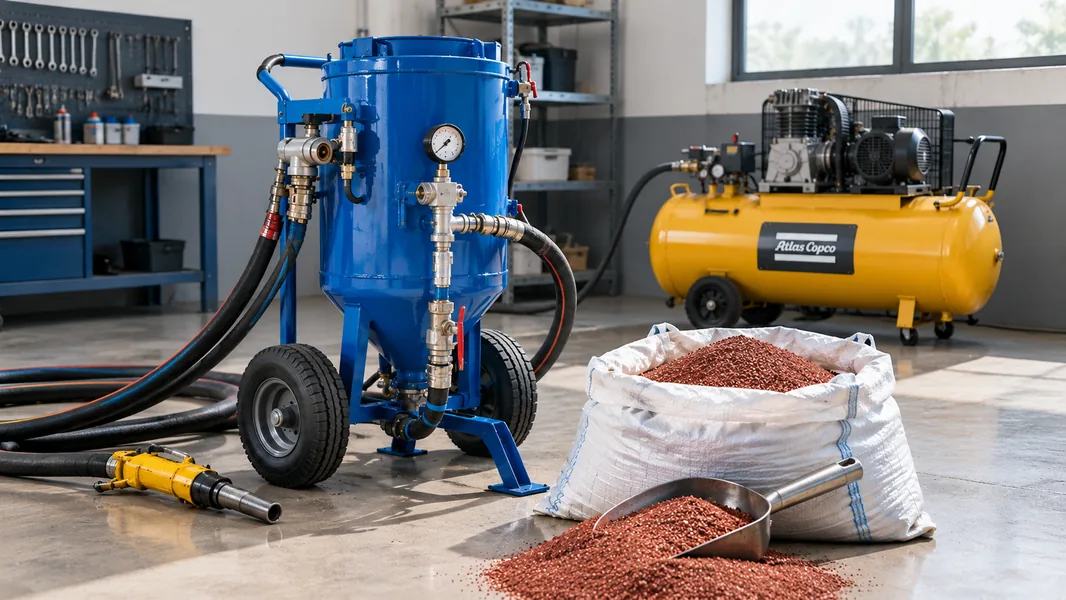
Sandblasting uses more air than a breaker, and the nozzle size sets the demand. A small blasting nozzle uses about as much air as a heavy breaker, and larger nozzles use several times more. The XAS 186 and XAHS 237 are the units we put on blasting jobs. You’ll find the blasting pots, cabinets and abrasives in our blasting equipment range.
Get the Right Compressor From Psilos Group
Tell us which tools you’re running and for how long, and we’ll match the compressor. We’ll also check your hose run and the pressure your tools need. Request a quote or call 7000 4994.
Frequently Asked Questions
What size air compressor do I need for a jackhammer?
Most handheld breakers use 50 to 90 cfm, so a compressor delivering around 90 to 110 cfm runs one. Our XAS 47 and XAS 57 are the usual starting points.
How many cfm does a jackhammer need?
It depends on the weight. Atlas Copco’s figures run from 53 cfm for a 19 kg breaker to 85 cfm for a 42 kg one.
Can one compressor run two jackhammers?
Yes, if it’s sized for both together. Two medium breakers need about 130 cfm, which our XAS 77 covers.
What’s the difference between a jackhammer and a breaker?
They’re usually the same tool, also called an air hammer or pneumatic hammer. “Breaker” is the trade name for the handheld tool that breaks concrete, asphalt and rock.
Does hose length affect a jackhammer?
Yes. A long or narrow hose loses pressure before the air reaches the tool, so keep runs short and size the compressor with headroom.
Can I run a jackhammer from a workshop compressor?
Usually not. Most workshop compressors deliver far less air than a breaker uses, so site work needs a towable diesel unit.
Do you hire air compressors in Cyprus?
Yes. We hire and sell Atlas Copco diesel compressors from our base in Limassol. Call 7000 4994 to check availability.


How to Choose Blasting Equipment in Cyprus: Machine, Abrasive and Compressor
Abrasive blasting strips rust, old paint and dirt from steel, concrete and facades. A good finish co
What Size Air Compressor Do You Need for a Jackhammer, Breaker or Drill?
A jackhammer is only as strong as the air behind it. On a compressor that’s too small, it hits
Battery power stations: a quiet backup-power alternative to a generator in Cyprus
A power cut in Cyprus rarely announces itself. One minute the lights are on, the next the fridge has